Resumes and CVs
Your resume is meant to be a clear, concise summary of why you are fit for a specific role or opportunity. It doesn't need to list everything you've done. It needs to show the experiences and qualifications that matter most for a specific application.
Before you start
Before you open a template and start filling it in, list things that you've done in the last few years: classes and projects, jobs, campus leadership roles, volunteering, church and mission work, clubs and sports. Next to each one, write what you did and one thing you're proud of. Most students find they have more to work with than they expected.
What employers look for
Employer surveys from the National Association of Colleges and Employers (NACE) keep putting teamwork, problem-solving and communication at the top of the list, along with the skills a specific job requires. Employers want evidence, so show those skills through what you did instead of simply listing them.
What goes on it
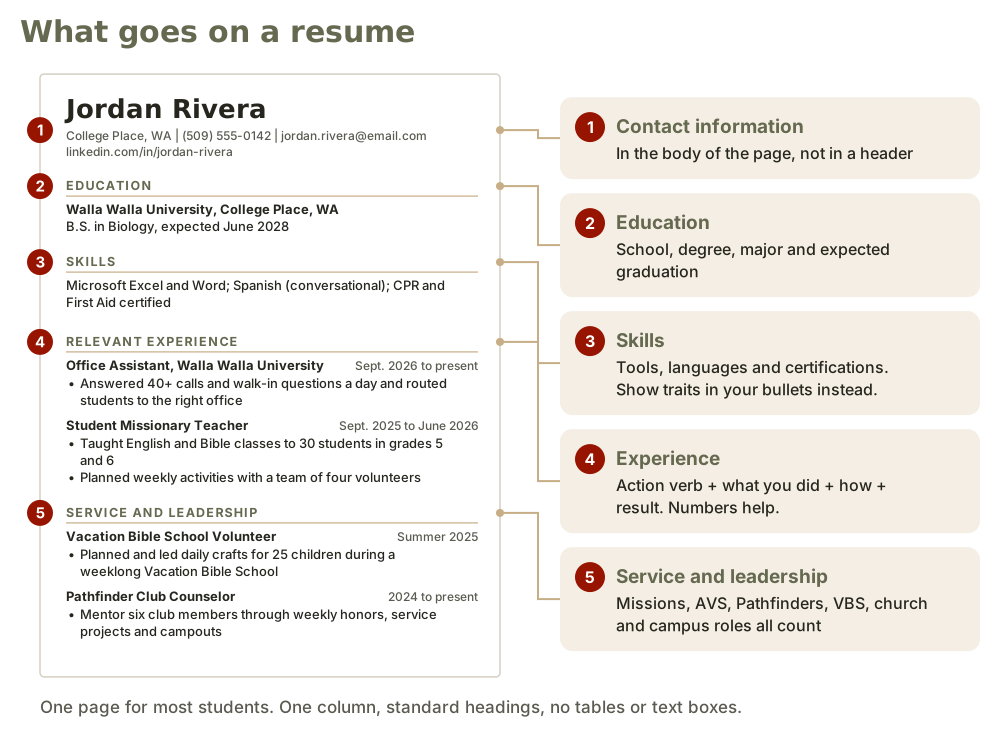
Most student resumes should follow this or a similar order:
- Contact information: name, phone, professional email, city and state, and a LinkedIn and/or portfolio link if you have one. Put it in the body of the page, not in a header.
- Education: Walla Walla University, your degree and major, and your expected graduation month and year. Add your GPA if asked for it, if what you’re applying for is academic or research-related, or if it otherwise strengthens your application. Relevant coursework and academic honors, awards, and scholarships can also go here.
- Skills: tools, software, languages, certifications, and lab or clinical skills. Leave out general traits like "hard worker" and show them in your bullets instead.
- Experience: jobs, internships, research, and other work tied to your field.
- Service and leadership: student missions, AVS, Pathfinders, VBS, church and campus roles, and volunteer work.
- Optional sections: projects, honors, and professional memberships.
Write bullets that show what you did
Start each bullet with an action verb. Then say what you did, how you did it and what happened as a result. Add numbers when you have them: how many people, how often, how much.
| Instead of | Try |
|---|---|
| Worked at the front desk | Answered 40+ calls and walk-in questions a day and routed students to the right office |
| Helped with VBS | Planned and led daily crafts for 25 children during a weeklong Vacation Bible School |
Make it fit what you are applying for
Read the posting closely and keep note of the skills and responsibilities it requires. Highlight your fit for the opportunity by using relevant experiences and matching the posting’s language where it truthfully describes what you did. Many employers screen applications with software before a person reads them, so keep the layout simple: one column, standard headings, and no tables, text boxes or graphics. Send as a PDF and include your name in the file name.
Count your whole story
Start with everything and shorten later. You may be surprised at how relevant some experiences can be when framed correctly. An experience such as a student missionary can show many positive traits such as adaptability and connection to mission, even if your responsibilities were not directly aligned to what you are applying for. Consider a “master resume” that includes everything you would potentially add in a resume that you “glean” from for each specific application.
Resume or CV?
A CV (curriculum vitae) is a longer, detailed record used for graduate school, research, teaching and some health professions. It includes things a resume usually leaves out, like research, presentations and publications. If an application asks for a CV, use our CV templates in Handshake. Graduate students and alumni applying to academic or research roles will usually need one.
Get the templates
Start with our general template and a sample:
Starter resume template (.docx)
Sample resume (pdf)
There’s no single perfect resume. The best one shows, clearly and concisely, how your skills fit the opportunity you’re interested in. Start with this template and make it your own. Ask a few people for feedback, especially people who work in the field you’re applying to, and keep the version that gets you interviews.
For a deeper walk-through, our resume and CV guides in Handshake cover each section in detail, with templates organized by field.
Get feedback
Once you have a draft, book an appointment. We'll go through it together, and you'll leave knowing what to change and why. Trading drafts with a classmate is a good first check too.
A note on AI
AI can be useful for things like suggesting stronger verbs or catching typos. It can also be a good way to double check fit with a specific posting. However, you are strongly encouraged to create your own materials. It is vital to take the time to think critically about your strengths, values, experiences, and professional goals and practice putting them into application materials yourself. You will be better prepared to articulate your fit during interviews and more confident in your approach overall.