Interviews and Offers
An interview is a conversation about whether you and a role fit each other. Interviewers want specific examples of what you've done. Your part is to prepare those stories, practice telling them out loud, and come with questions of your own.
Know the format
These are common interview formats. You may encounter different ones, but this is a good place to start.
- Phone or video screens: short first conversations, often with a recruiter or HR representative.
- Recorded video interviews: you answer questions on screen with no one on the other end. Practice looking at the camera and keeping to the time limit.
- Behavioral interviews: "Tell me about a time when..." questions about real situations you've handled.
- Panel interviews: several interviewers at once. Speak to the whole group, not just the person who asked.
- Skills or technical interviews: problems, case questions or tasks tied to the job.
Prepare your examples
Employers listen for evidence of skills like teamwork, problem-solving and communication. Before any interview, pick six to eight experiences you could talk about: a problem you solved, a team you were part of, a time something went wrong, a time you took the lead. For each one, jot down what happened, what you did and what changed. Don’t feel the need to memorize your answers. Rather, focus on having a repository of stories that will come to mind to highlight your strengths.
Ways to structure an answer
There's no single right formula. Try a few and use what feels natural to you.
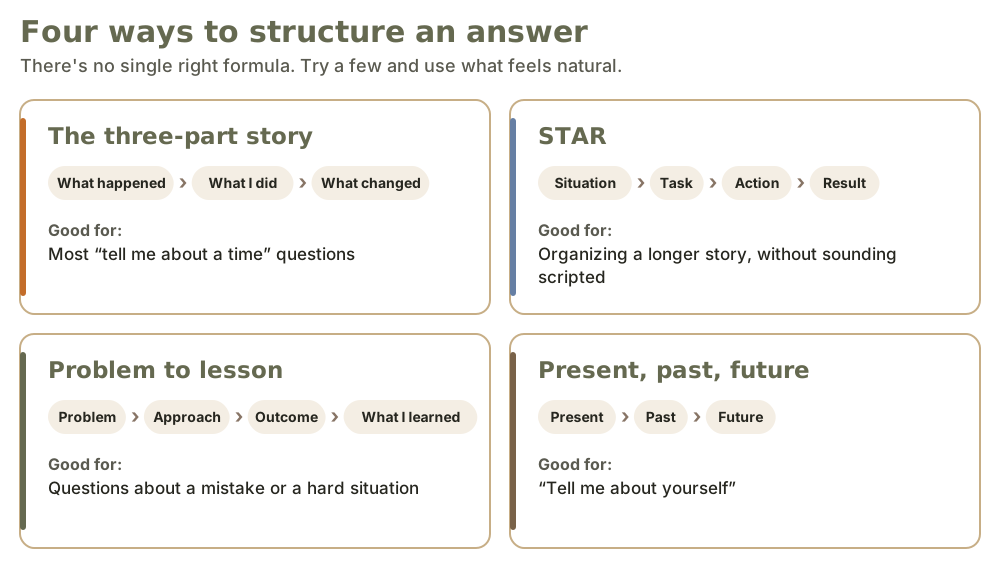
- What happened, what I did, what changed. A simple three-part story that works for most "tell me about a time" questions.
- Situation, Task, Action, Result (STAR). A common framework. It helps you organize, but don't let it make you sound scripted.
- Problem, approach, outcome, what I learned. Useful when a question asks about a mistake or a hard situation.
- Present, past, future. For "tell me about yourself": what you're doing now, how you got here and what you want next.
Whichever you use, be specific. A real example with details tells an interviewer far more than a list of qualities.
After the interview
Send a short thank-you email within a day to each person you met and mention something specific from your conversation.
Weighing an offer
- Ask for the offer in writing, including pay, start date and benefits.
- Look at the whole picture: pay, benefits, location and cost of living, schedule, the people and room to grow.
- Research typical pay for the role with the Occupational Outlook Handbook, O*NET OnLine or CareerOneStop. In Washington, employers with 15 or more employees have to list a pay range in job postings, so check the original posting too.
- It's reasonable to ask for a few days to decide.
- If you negotiate, be specific and respectful. Thank them, name what you're asking for, and give a reason based on your research or experience.
Practice out loud
Say your answers out loud, not just in your head. Record yourself, practice with a friend, or book a mock interview with us. Afterward, we'll talk through what came across well and what to work on.
Questions to ask them
Prepare three or four. Here are good examples:
- What are some qualities that previous employees have had that have made them successful in this role?
- How does the team work together?
- What do you enjoy about working here?
- What are the next steps?
Skip anything the website already answers. Skip negative questions or specific questions about salary, benefits, vacation time, etc. Unless they bring them up first, these questions, along with negotiation, are best saved for after you receive an official job offer.
International students
Confirm your work authorization timeline before you agree to a start date.
Get the tools
Practice questions and an offer comparison worksheet are in Handshake.