Grad and Professional School
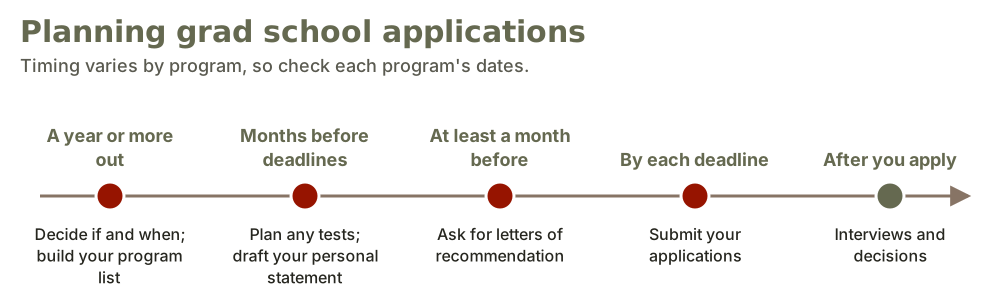
Graduate and professional programs look for applicants who know why they're applying. Start planning a year or more before you begin, so you have time for tests, reference letters and a strong personal statement.
Decide if and when
Talk with faculty in your field and with people who hold the degree you're considering. Ask whether the work you want needs the degree now, later or not at all. Some fields value a few years of work experience first.
Planning on a health career?
Medicine, dentistry, pharmacy, physical therapy and other health programs have their own requirements and timelines. Start with the Center for Health Professions.
Build your list
For each program, compare admission requirements, deadlines, cost, funding and what graduates go on to do. Program websites are the best source, and most list someone to contact with questions. Considering WWU? See WWU Graduate Programs.
Your personal statement
Your statement answers three questions: why this field, why now and why you're ready. Start with a specific moment or experience, connect it to what you want to study, and end with where you're headed. Ask a few people to read it and plan to revise more than once.
Entrance exams
Some programs have dropped entrance exams and others still require them. Check each program, then plan a test date that leaves time to retake if you need to.
Official test information: GRE (ETS), LSAT (LSAC), MCAT (AAMC).
Letters of recommendation
Ask at least a month before the deadline. Choose people who know the quality of your work well, and consider giving them your resume, a draft of your statement, the deadlines and a short note on what you hope they'll mention.
Your CV
Many programs ask for a CV instead of a resume. See Resumes and CVs for the difference and for templates.
Get the tools
A personal statement guide and a planning timeline are in Handshake.
Book an appointment to plan your applications or to go over a statement draft.